

Analysis of Europe’s Housing Stock: What Share of Conventional Dwellings Is Actually Used as Usual Residences?
Jure Taraš
2/10/2026
Europe’s housing crisis has raised numerous questions, one of which concerns the extent to which the existing housing stock is actually used for permanent living, as opposed to being vacant or only occasionally occupied. A high share of vacant dwellings, short-term rental units, as well as second homes and dwellings used for seasonal or temporary purposes reduces both the affordability and availability of housing for permanent residents. Taking this into account, the way in which housing stock is used has become an increasingly important issue in discussions on how to address Europe’s housing crisis.
Historically, the growth in the number of unoccupied conventional dwellings has been driven by emigration and internal migration from rural areas to urban centres. As a result, higher concentrations of unoccupied dwellings are often observed in rural areas. In urban contexts, unoccupied conventional dwellings also emerge as a consequence of real estate investment. The purchase of residential property has increasingly become an investment opportunity for both domestic and foreign buyers, with dwellings sometimes remaining vacant or underutilised. The continuous rise in property prices has further encouraged investment aimed at resale and short-term profit (property flipping, buy-to-flip). Such practices are observable across European housing markets and increasingly exert upward pressure on both rents and housing prices, as investors compete directly with end users.
This analysis draws on data from Eurostat and national statistical offices, based primarily on population and housing census data from 2021. According to the results, at the level of the European Union, approximately 80% of the housing stock is used as usual residences, while the remaining 20% consists of vacant dwellings, second homes, and dwellings used for seasonal or other purposes. At the country level, the share of housing stock used for permanent living varies considerably across Europe, ranging from approximately 55% to 95%, with pronounced regional differences.
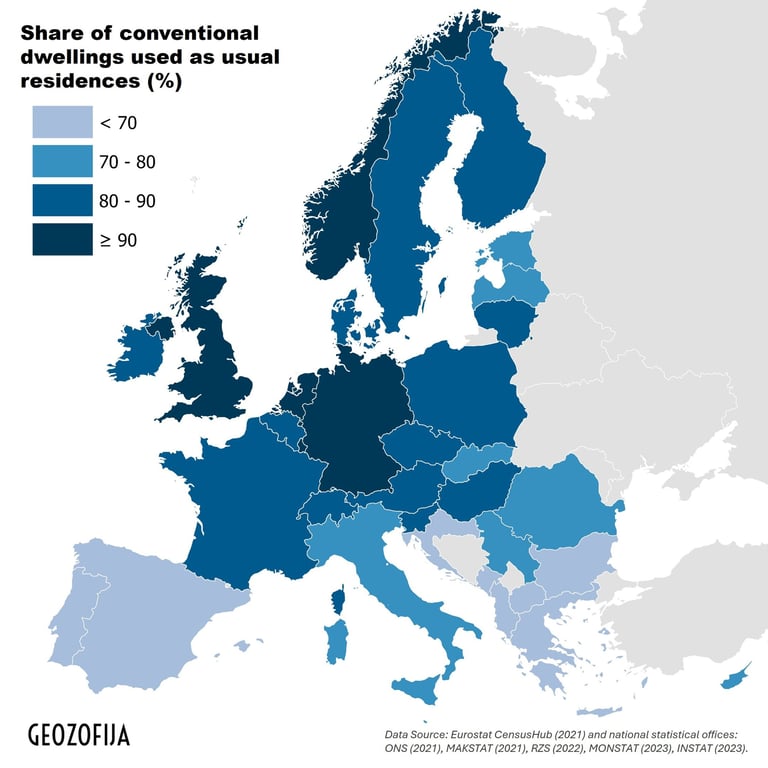
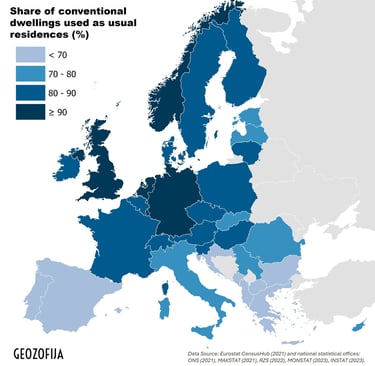
From a regional perspective, countries in Western, Central, and Northern Europe record the highest shares of conventional dwellings used as usual residences. In these countries, more than 80% of the housing stock is used for permanent living, exceeding 90% in the Netherlands, Luxembourg, the United Kingdom, Norway, and Germany. These figures reflect relatively effective housing and taxation policies and indicate that housing stock is largely used for its primary purpose — residential use.
In contrast, countries in Southern and South-Eastern Europe record substantially lower shares, with less than 70% of the housing stock used as usual residences. This is largely the result of developed tourism sectors, a high prevalence of second homes and short-term rental units, as well as housing and tax policies that have not sufficiently mitigated the impact of tourism on housing markets. For example, in Portugal, 69% of the housing stock is used as usual residences, while the remaining 31% consists of second homes (19%) and vacant dwellings (12%). The situation is most pronounced in Montenegro, where only 55% of the housing stock is used for permanent living, and in Croatia, where the share amounts to 60%.
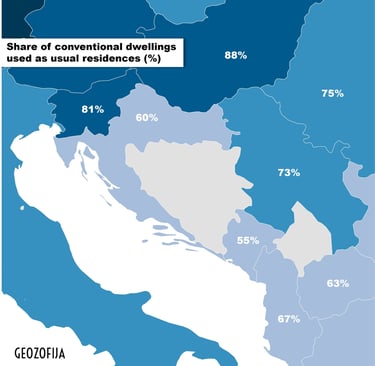
South-Eastern Europe stands out as a regional outlier, recording some of the lowest shares of conventional dwellings used as usual residences. In countries such as Montenegro, Croatia, North Macedonia and Albania, less than 70% of the housing stock is used for permanent living. This pattern reflects a combination of factors, including strong tourism pressures, a high prevalence of second homes, and specific structural characteristics of housing markets in the region. In some countries of South-Eastern Europe, reports have highlighted vulnerabilities related to real estate investment and illicit financial flows, which may further contribute to elevated shares of non-resident and underutilised dwellings.
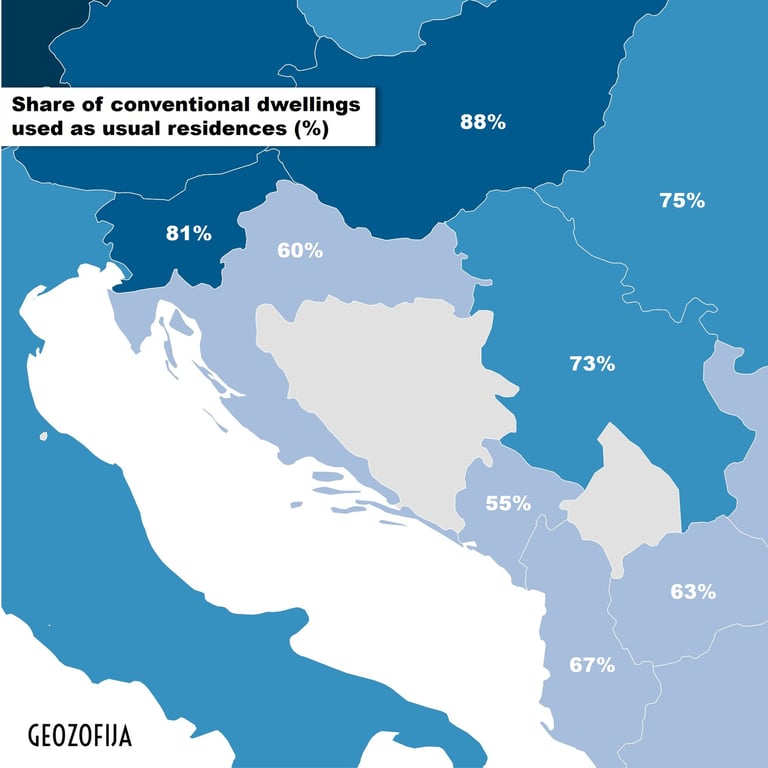
The analysis draws on population and housing census data from 2021 obtained via Eurostat CensusHub, complemented by data from national statistical offices for countries not covered by the Eurostat database. These include the Office for National Statistics of the United Kingdom (2021), the Statistical Office of North Macedonia (2021), the Statistical Office of the Republic of Serbia (2022), the Statistical Office of Montenegro (2023), and the Institute of Statistics of Albania (2023). According to Eurostat’s methodology, occupied conventional dwellings are defined as dwellings that serve as the usual place of residence for one or more persons at the time of the census. Further details on the methodology are available via Eurostat.
My name is Jure Taras. I hold a Master’s degree in Geography, earned at the Faculty of Science, University of Zagreb. More information about my background and professional experience is available on my LinkedIn profile. I am open to new ideas and opportunities.
*Reproduction is permitted with proper source attribution. For additional information or inquiries, you may contact me.