
Analysis: Which European countries have the most young adults living with their parents?
Jure Taraš
7/10/2026
Young men are significantly more likely to remain in the parental home than women
Eurostat’s data shows that across all surveyed nations, men aged 25 to 34 remain in the parental home at higher rates than women. This gender gap is especially pronounced in southern and southeastern Europe, where the share of young men living with parents consistently exceeds 50%. The phenomenon peaks in Albania (94%), Montenegro (82%), North Macedonia (77%), and Croatia (72%). Intriguingly, the proportion of Albanian women in the same age bracket living at home is 2.5 times lower, standing at 37%. This disparity is a byproduct of cultural norms and patriarchal upbringing, which looks benignly upon men staying at home while traditionally expecting women to leave their primary families earlier.
Ireland records the sharpest increase in young adults living with parents
Between 2015 and 2025, the proportion of 25-to-34-year-olds living with their parents across the EU remained relatively stable at around 30%, though individual nations experienced highly divergent trajectories. Ireland recorded the most dramatic surge, with its share jumping by 16 percentage points - from 22% in 2015 to 38% in 2025. It is followed closely by Cyprus (up 16 percentage points), Spain (up 11), and Croatia, where the figure climbed from 56% to 62%. Conversely, the sharpest declines were documented in Czechia and Lithuania, dropping by 12 and 18 percentage points, respectively. But where these numbers continue to swell, the problem morphs from a real estate crisis into a human one: this prolonged dependence often carries a heavy social toll, delaying partnership and family formation while taking a clear hit on the mental well-being of young adults.
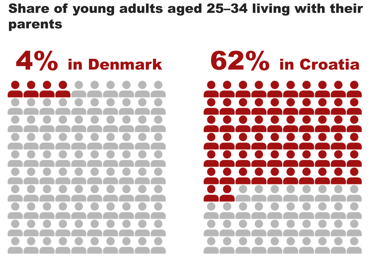
In Croatia, the share of young adults living with parents is double the EU average
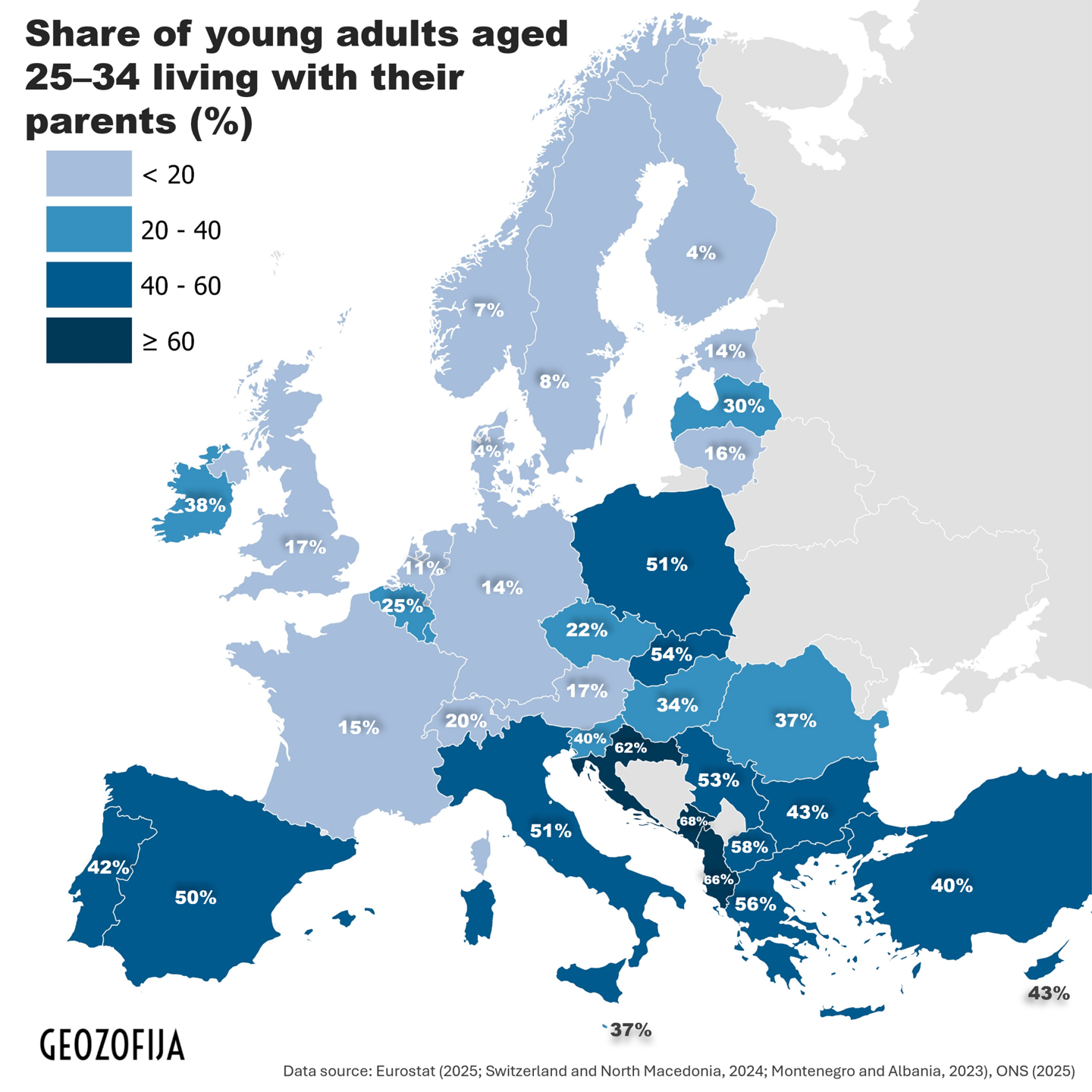
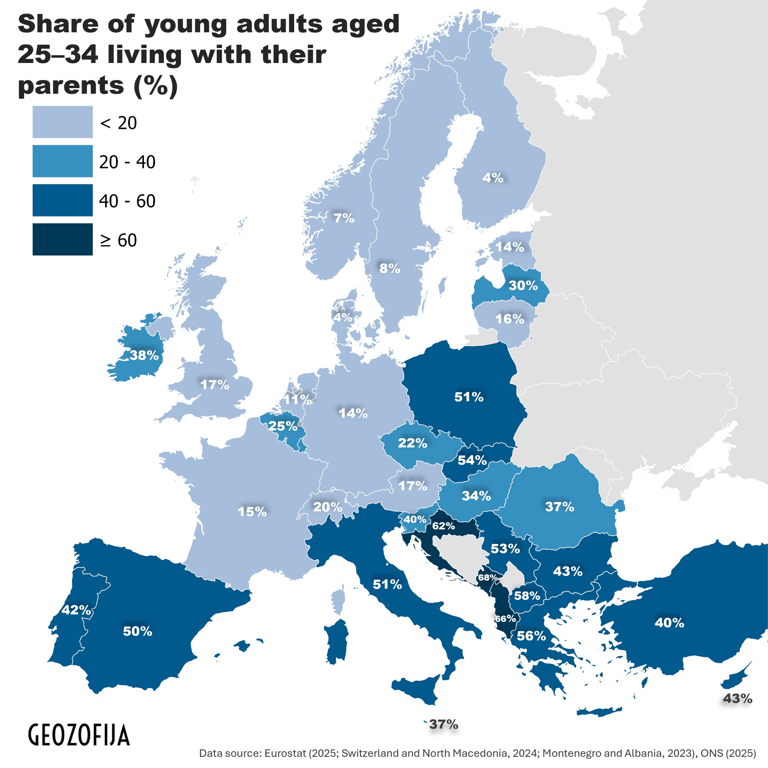
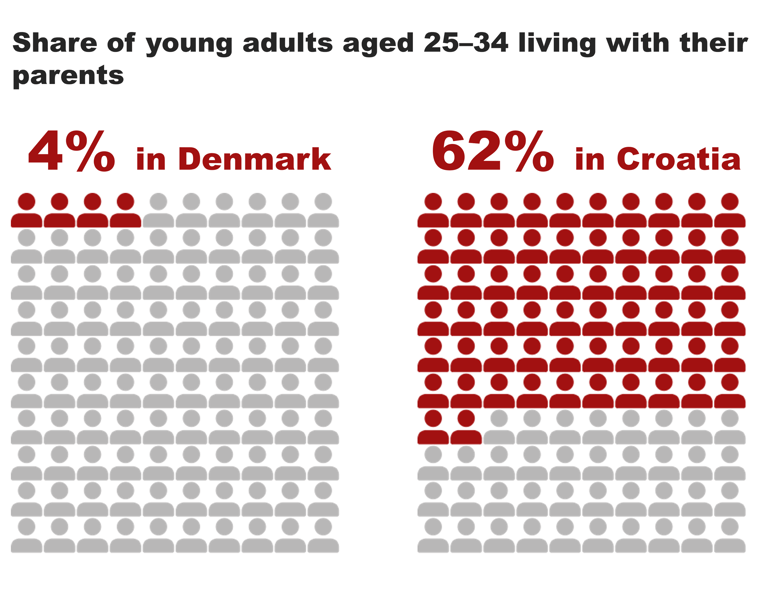
Across the European Union, an average of 30% of young adults aged 25 to 34 still reside in the parental home. Croatia, however, sees more than double that figure: a striking 62% of its youth live with their parents, putting the country at the very top of the EU rankings. At the opposite end of the spectrum lies Denmark, where a mere 4% of 25-to-34-year-olds remain under their parents' roof.
At the EU level, 61% of young adults aged 25 to 34 who still live at parental home are actually employed. The data underscores a crucial reality: the crisis isn't driven by the job market, but by a skyrocketing housing market defined by compounding year-over-year increases in rent and real estate prices.
Driven by a severe housing crunch, surging rent costs, and soaring real estate prices, the rising cost of living has created deep uncertainty for young Europeans, who are increasingly delaying independent living.
An analysis of Eurostat data reveals stark regional disparities in the proportion of 25-to-34-year-olds remaining in the parental home. In Nordic countries, the share of young adults under the family roof fluctuates between just 4% and 8%. By contrast, across parts of southern and southeastern Europe, more than half of this demographic still lives with their parents.
Author: Jure Taraš, MSc in Geography
I hold a degree from the Faculty of Science, University of Zagreb. I specialize in data analysis and visualization, transforming complex datasets into clear narratives about economic and social trends. My particular interests include spatial analysis applied to economics, data journalism, and data visualization. I am open to new projects and opportunities - you can learn more about me on my LinkedIn profile.
*Reproduction is permitted with proper attribution to the source and prior contact. For additional information, comments, or inquiries, please reach out via the contact form.
Methodology note: This analysis is based on data from Eurostat and the UK’s Office for National Statistics (ONS). For a detailed overview of data collection methods, consult Eurostat’s methodology guidelines.