
Where in Europe Are Housing and Food Prices Rising Faster Than Wages?
Jure Taraš
4/3/2026
The war in the Middle East, the blockade of the strategically vital Strait of Hormuz for global trade, and attacks on and damage to energy infrastructure across the region have all undermined global energy stability. As the energy crisis deepens and spills over into multiple sectors, it is emerging as a tangible threat to consumers who are already significantly strained by the repercussions of Russia’s invasion of Ukraine and the lingering effects of the pandemic crisis in recent years.
This analysis compares how much housing and food prices have increased relative to the growth of average net salaries over a five-year period, from the pre-pandemic year of 2019 to 2024. Housing and food represent basic living necessities, yet in recent years, rising prices in these categories have not been matched by comparable growth in average salaries.
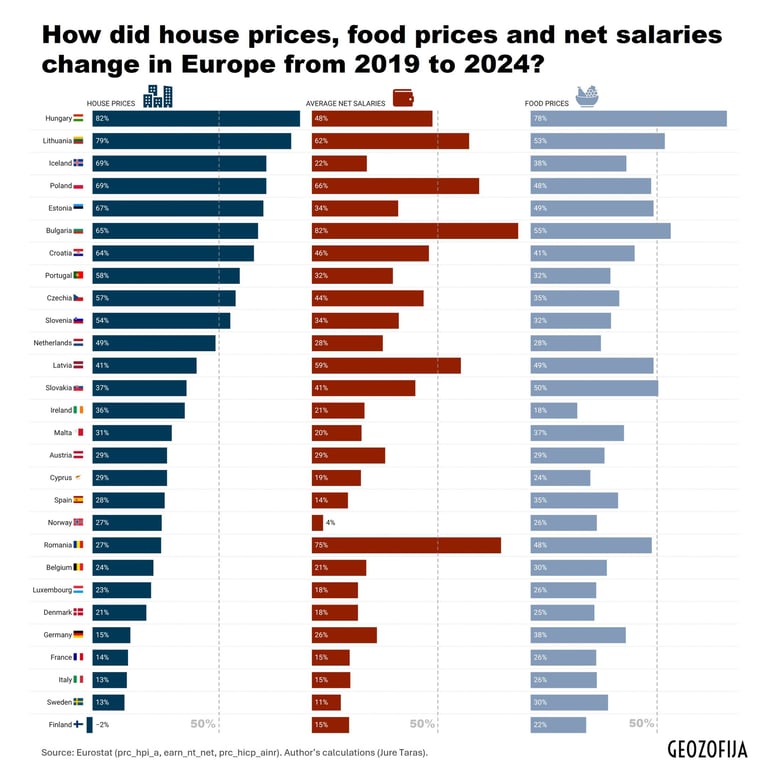
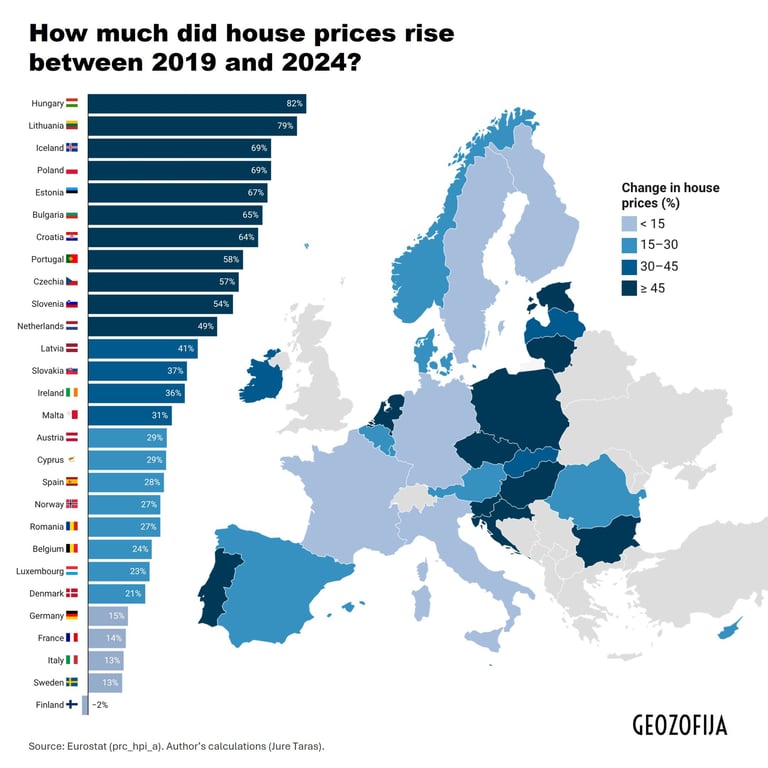
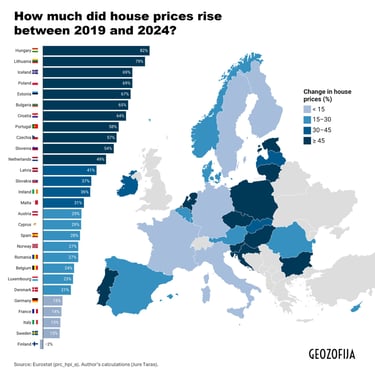
Between 2019 and 2024, housing prices increased the most in Hungary, with an 82% rise over this period. Other countries at the top of the list include Lithuania, Iceland, Poland, Estonia, Bulgaria, and Croatia, where growth exceeded 60%. Prices rose the least in Germany, France, Italy, and Sweden, with increases ranging between 10% and 15%. The only European country to experience a decline in housing prices was Finland, where prices fell by 2%. This exception in the European real estate market is attributed to lower demand, higher interest rates, and general economic uncertainty.
Over the same period, average net salaries increased the most in the former socialist countries of Europe, which are catching up with the continent’s more developed economies. The highest growth in average salaries was recorded in Romania (75%) and Bulgaria (82%), while in other post-socialist countries, salary growth generally exceeded 40%. In the rest of Europe, growth in average salaries was more moderate, mostly ranging between 15% and 30%.
Alongside housing prices, rising food costs are also putting pressure on average net salaries. A prime example is Hungary, where food prices rose by 78% and housing prices by 82%. Besides Hungary, food prices rose the most in Lithuania (53%), Bulgaria (55%), and Slovakia (50%). In the post-socialist countries, food price growth, like salary growth, generally exceeded 40%. In other European countries, increases in food prices were also significant, ranging between 20% and 40%.
When analyzing the gap between price growth and the increase in average net salaries, it becomes clear that over the five-year period from 2019 to 2024, salary growth has largely failed to keep pace with rising housing and food costs. In most countries, prices increased faster than salaries or roughly matched wage growth.
In Croatia, housing prices have risen 18 percentage points faster than average net salaries, while food prices have increased 5 percentage points less than salary growth. This suggests that wage growth is somewhat keeping up with rising food costs, but housing is becoming increasingly unaffordable.
*Methodological note: Changes in average net wages are calculated using data reported in euros. In countries outside the euro area, comparability is also affected by exchange rate movements, while price indices (HPI and HICP) measure changes in prices in national currencies.
Author: Jure Taraš, MSc in Geography
I hold a degree from the Faculty of Science, University of Zagreb. I specialize in data analysis and visualization, transforming complex datasets into clear narratives about economic and social trends. My particular interests include spatial analysis applied to economics, data journalism, and data visualization. I am open to new projects and opportunities - you can learn more about me on my LinkedIn profile.
*Reproduction is permitted with proper attribution to the source and prior contact. For additional information, comments, or inquiries, please reach out via the contact form.
The analysis is based on Eurostat data. Housing market trends were measured using the House Price Index (HPI, prc_hpi_a), while food price developments were tracked using the Harmonised Index of Consumer Prices (HICP – CP011 Food, prc_hicp_ainr). Average net salaries were analyzed using the indicator for annual net earnings of a single person without children earning 100% of the average wage (earn_nt_net). The data were further processed to support comparative and time-series analysis.